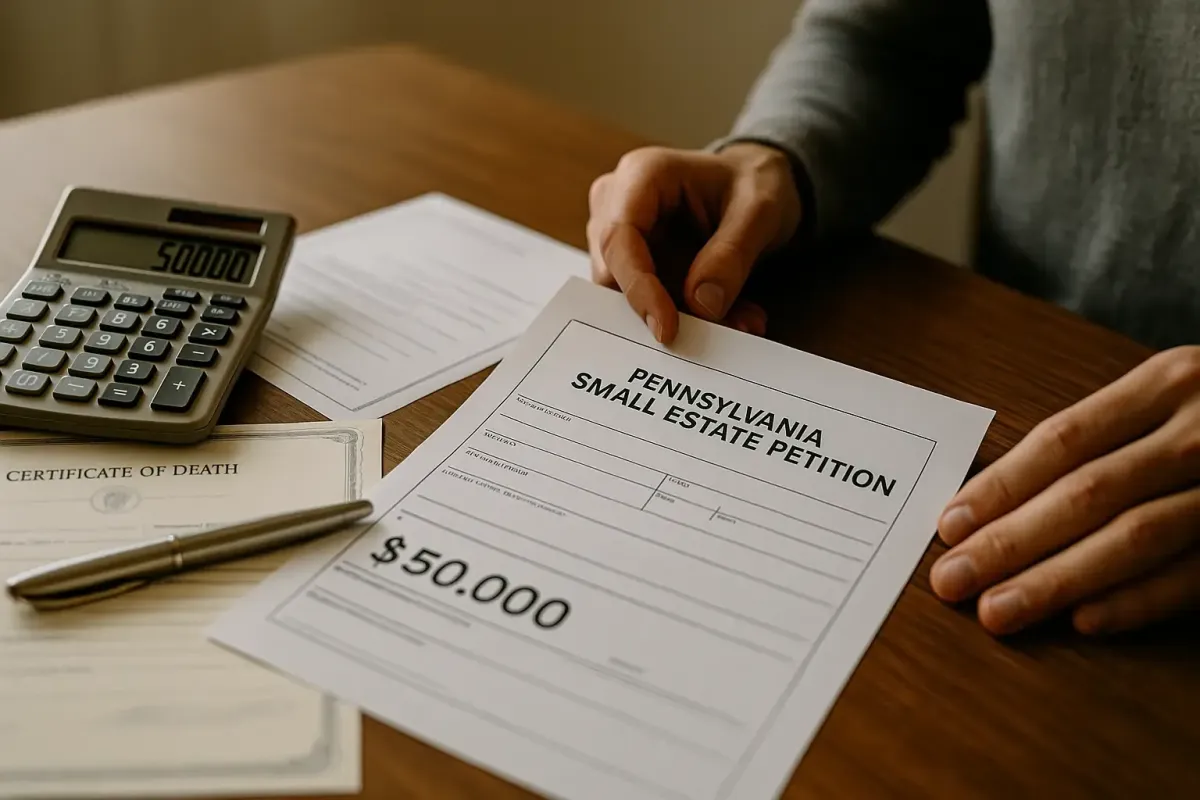
Understanding the $50,000 Rule PA Small Estate | PA Probate Help
Understanding the $50,000 Rule in Pennsylvania Probate

Key Takeaways
Pennsylvania's $50,000 rule allows simplified probate for qualifying estates. If the deceased's personal property (excluding real estate) totals $50,000 or less, the estate may qualify for Pennsylvania's small estate procedure under 20 Pa.C.S. § 3102. This speeds up asset distribution and reduces costs significantly compared to full probate.
Real estate doesn't count toward the $50,000 threshold - but it triggers full probate anyway. The $50,000 calculation excludes all real property regardless of value. However, if the deceased owned any real estate in their name alone, you must go through regular probate no matter how small the total estate value is. This surprises many people.
Small estate procedures eliminate some probate costs but not all obligations. Using the small estate process avoids Register of Wills fees, publication expenses, and some administrative burdens. But you still must pay creditors, file inheritance tax returns, and distribute assets properly. The small estate procedure is a shortcut, not a free pass.
Multiple tiers exist for very small estates under $10,000. Pennsylvania actually has several levels of simplified procedures. Estates under $10,000 can use an even simpler affidavit process through financial institutions directly. Understanding which tier applies to your situation determines the right approach.
What Is Pennsylvania's $50,000 Small Estate Rule?
The small estate procedure exists because full probate makes little sense for modest estates. When someone dies owning $15,000 in bank accounts and nothing else, forcing heirs through the entire formal probate process - with all its fees, delays, and paperwork - eats up a disproportionate share of what little there is to inherit.
Pennsylvania law addresses this through 20 Pa.C.S. § 3102, which allows interested parties to petition the Orphans' Court directly for distribution of estates valued at $50,000 or less in personal property. Instead of opening a formal estate at the Register of Wills, getting Letters Testamentary, advertising the estate, and following all the regular probate steps, you file a petition with the court asking it to approve your proposed distribution.
The court reviews the petition, makes sure creditors are addressed, confirms the proper heirs or beneficiaries, and issues a decree directing distribution. This typically happens much faster than full probate and costs significantly less.
Here's what many people don't understand about this rule - it's optional, not mandatory. Even if an estate qualifies as a small estate, you can still choose to go through regular probate if that makes more sense for your situation. Some executors prefer the structure and protection of formal probate even when the small estate option exists. That's perfectly fine.
I worked with a family last year where the deceased left $42,000 in bank accounts and no real estate. Classic small estate situation. But there were disputes between siblings about distribution, and the appointed executor wanted the protection of formal court oversight. They voluntarily went through full probate instead of using the small estate procedure, which was absolutely the right call given the family dynamics.
What Assets Count Toward the $50,000 Threshold?
Understanding what does and doesn't count toward the $50,000 limit is crucial for determining whether you qualify for small estate treatment.
Personal property in the deceased's name counts. This includes bank accounts solely in the deceased's name, investment accounts without beneficiary designations, vehicles titled only to the deceased, personal belongings, and any other assets owned individually. Basically, anything that would normally go through probate counts toward your $50,000 calculation.
Real estate never counts - but it disqualifies you anyway. The statute specifically excludes real estate from the $50,000 calculation. But here's the catch - if the deceased owned any real property in their name alone, you can't use the small estate procedure regardless of the property's value. A $45,000 estate with a $20,000 piece of land requires full probate. A $45,000 estate with no real estate can use the small estate procedure.
This real estate exception surprises people constantly. I've had executors call excited about using the small estate process because the deceased only had $30,000 in accounts. Then I ask about real estate and they mention a small parcel of land or a half interest in the family home. Full probate required. The small estate procedure simply doesn't apply when probate real estate is involved.
Non-probate assets don't count. Property that passes outside probate doesn't factor into the $50,000 threshold. Life insurance with named beneficiaries? Doesn't count. Joint bank accounts with survivorship rights? Doesn't count. Retirement accounts with beneficiary designations? Doesn't count. Assets in revocable trusts? Doesn't count. You only count assets that would otherwise require probate administration.
Family exemption amounts don't count. Pennsylvania allows up to $3,500 in property to be set aside as a family exemption. This amount is excluded from the $50,000 calculation under the statute.
How Does the Small Estate Petition Work in Pennsylvania?
The actual process for using Pennsylvania's small estate procedure is straightforward, though county practices vary slightly.
File a petition with the Orphans' Court. Instead of going to the Register of Wills to open a probate estate, you prepare and file a Petition for Settlement of Small Estate with the Orphans' Court Clerk in the county where the deceased lived. This petition includes information about the deceased, details of all assets, identification of debts and expenses, and your proposed distribution to heirs or beneficiaries.
The inheritance tax return must still be filed. This is non-negotiable. Many Pennsylvania counties require you to file the Pennsylvania inheritance tax return (REV-1500) at the same time as your small estate petition. Even if your county doesn't require simultaneous filing, the inheritance tax obligation still exists and must be satisfied before final distribution.
Notice requirements still apply. You must provide notice to interested parties - beneficiaries, heirs, and known creditors. The court will specify what notice is required. While you skip the published estate notice required in full probate, you still need to ensure people with an interest in the estate know what's happening.
The court reviews and issues a decree. The Orphans' Court judge reviews your petition to make sure everything appears proper. If satisfied, the court issues a Decree of Distribution directing whoever holds the deceased's assets (banks, investment companies, etc.) to transfer them according to your proposed distribution. This decree gives you the legal authority to collect and distribute assets.
You distribute assets and close the estate. With the decree in hand, you collect the deceased's assets and distribute them according to the will or intestacy laws after paying any creditors and taxes. Unlike formal probate, there's typically no final accounting required with small estate procedures, though you're still responsible for handling everything properly.
What About Estates Under $10,000?
Pennsylvania has even simpler procedures for very small estates valued under $10,000.
Direct payment from financial institutions. Under 20 Pa.C.S. § 3101, banks and other financial institutions can release up to $10,000 directly to the deceased's surviving spouse, child, parent, or sibling (in that order of priority) without any court involvement whatsoever. The family member just needs to present a death certificate and proof that funeral expenses have been paid.
This isn't technically a probate procedure at all - it's a statutory authorization for financial institutions to release funds directly. The person receiving the money doesn't become a formal executor or personal representative. They're just authorized to collect and are responsible for using the funds appropriately.
Employer payments up to $10,000. Employers can pay up to $10,000 in wages, salary, or compensation directly to surviving family members in the same priority order, with no probate required.
Insurance proceeds up to $11,000. Life insurance companies can pay up to $11,000 in proceeds directly to surviving family members if no personal representative claims the money within 60 days of death.
These sub-$10,000 provisions serve a practical purpose - they let surviving families access modest amounts of money quickly to handle immediate expenses without any court process. But there's an important catch: the person who receives these payments is still responsible for paying creditors and taxes appropriately. Taking the money doesn't eliminate estate obligations.
What Are the Advantages of Small Estate Procedures?
Understanding the benefits helps you decide whether to use small estate procedures when you qualify.
Significant cost savings are the most obvious advantage. Regular probate involves filing fees with the Register of Wills, probate bonds in some cases, mandatory publication expenses, and typically attorney fees for navigating the process. Small estate procedures eliminate or reduce many of these costs. For a $35,000 estate, saving even $1,000-2,000 in fees means beneficiaries receive substantially more.
Faster distribution benefits heirs who need access to assets. Full probate in Pennsylvania typically takes 9-12 months minimum, often longer. Small estate procedures can sometimes be completed in a few months, allowing beneficiaries to receive their inheritance more quickly. For families dealing with funeral expenses or other immediate needs, this speed matters.
Less administrative burden makes the executor's job simpler. You don't have to advertise the estate, file regular status reports, or prepare detailed formal accountings. The reduced paperwork and fewer procedural requirements mean less work overall.
More privacy results from avoiding the public probate process. Regular probate filings become public records. Small estate petitions may receive less public visibility, though they're not completely private either.
What Are the Disadvantages and Limitations?
Small estate procedures aren't right for every qualifying estate. Understanding the drawbacks helps you make informed decisions.
Real estate immediately disqualifies you. This is the biggest limitation. Any real property owned solely by the deceased means you can't use the small estate process, period. Even if the real estate is worth $10,000 and that's the only asset, you need full probate. Many families discover this limitation too late.
Creditor protection may be weaker. In full probate, the publication requirement and formal creditor claims process provides a clear framework for dealing with debts. Small estate procedures lack some of these protections. If significant unknown creditors exist, formal probate's structured approach might be safer.
Disputes need formal probate. If beneficiaries disagree about distribution or someone wants to contest the will, small estate procedures don't provide the framework for resolving disputes. Complex family situations often benefit from the structure of formal probate.
Executor protection is reduced. Formal probate, when completed properly with court approval of final accountings, provides executors with significant protection from future claims. Small estate procedures offer less formal closure and potentially less protection.
Some banks prefer formal letters. Occasionally, financial institutions or other asset holders are reluctant to release assets based on a small estate decree, preferring the more familiar Letters Testamentary. While they're legally required to honor valid court decrees, the practical reality is that Letters sometimes make the asset transfer process smoother.
Frequently Asked Questions
Q: Can I use the small estate procedure if there's a will?
A: Yes, absolutely. The small estate procedure applies whether the deceased died with a will (testate) or without one (intestate). If there's a will, assets still distribute according to its terms - the small estate procedure just simplifies the legal process for getting the distribution done. The will still needs to be filed with the Register of Wills, but you're using the small estate petition instead of formal probate to distribute the assets.
Q: What if I calculated wrong and the estate is actually worth more than $50,000?
A: This happens sometimes when unknown assets surface after you've filed a small estate petition. If you discover additional assets that push the total over $50,000, you'll typically need to close the small estate proceeding and open formal probate. This is why it's crucial to thoroughly identify all assets before deciding which process to use. When in doubt, a careful asset search is worth the time.
Q: Do I still need an attorney for a small estate petition?
A: It's not legally required, but many people find attorney guidance helpful even for small estates. The petition paperwork can be completed by anyone, but understanding inheritance tax obligations, proper asset valuation, creditor priorities, and distribution rules requires legal knowledge. Many attorneys offer limited-scope services for small estates at reduced fees. Weigh the attorney cost against the estate value and complexity to decide what makes sense.
Q: How long does the small estate process take in Pennsylvania?
A: It varies by county and circumstances, but small estate petitions are typically resolved in 2-4 months from filing to receiving the court's decree - significantly faster than the 9-12 months (or longer) that full probate usually requires. However, you still need to wait for inheritance tax clearance before making final distributions, which can add time. The process is faster than regular probate but still isn't instant.
Choose the Right Probate Path for Your Estate
Pennsylvania's small estate procedures offer real advantages for qualifying estates, but they're not always the best choice even when available. Understanding the $50,000 rule, what counts toward it, and how the process works helps you make smart decisions about estate administration.
If you're dealing with an estate that includes real property, the small estate option isn't available regardless of value. Working with a probate real estate specialist can help you navigate property issues efficiently while managing the full probate process.
Contact PA Probate Help to discuss your specific situation, or download our free Pennsylvania probate guide for comprehensive information on all probate procedures in Pennsylvania.
