
A COMMITMENT TO CLARITY & SUPPORT THROUGHOUT YOUR PROBATE PROCESS
Executor Duties & Responsibilities in Pennsylvania
A clear guide to executor authority, legal responsibilities, timelines, and common mistakes under Pennsylvania probate law.
Serving as an executor in Pennsylvania means taking on a fiduciary role with legal and financial responsibility. Executors are personally responsible for safeguarding estate assets, complying with probate court requirements, paying debts and taxes, and distributing property correctly. This guide explains what executors must do, when each responsibility applies, and how to carry out the role with confidence.
Executor-focused guidance
Pennsylvania-specific probate requirements
Step-by-step responsibility breakdown
Understanding the Executor’s Role in Pennsylvania
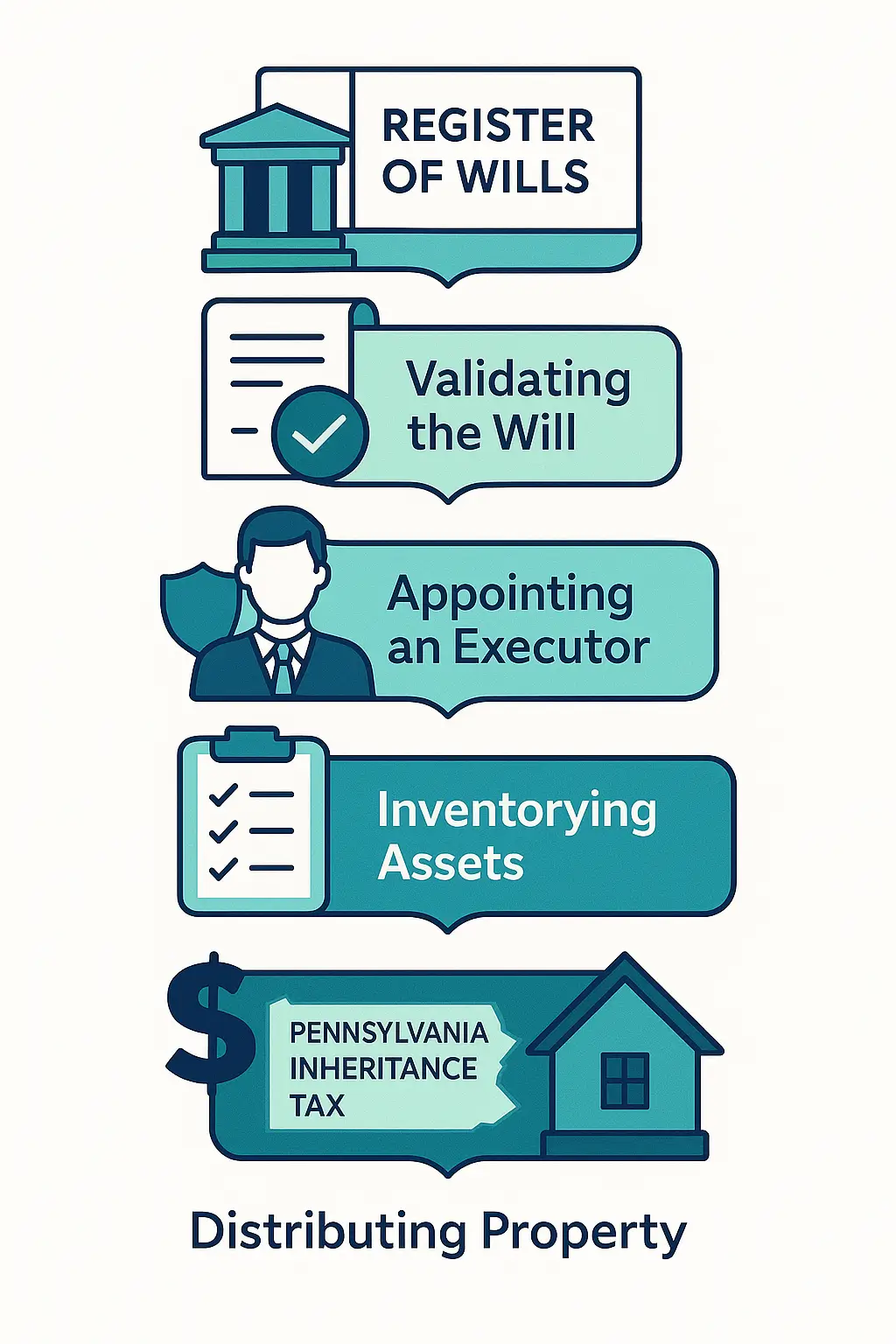
An executor, also referred to as a personal representative, is the individual legally appointed to manage and settle a deceased person’s estate through the Pennsylvania probate process. In Pennsylvania, executors act as fiduciaries, which means they are legally required to act in the best interests of the estate and its beneficiaries at all times. Once the Register of Wills issues Letters Testamentary or Letters of Administration, the executor has the authority to take control of estate assets, complete required filings, and move the estate toward closure.
Executor responsibilities typically include:
Accepting the appointment and confirming legal authority
Securing and managing estate assets
Identifying and communicating with beneficiaries
Providing required notices to beneficiaries and creditors
Inventorying and valuing estate property
Paying valid debts, expenses, and required taxes
Distributing assets according to the will or Pennsylvania intestacy law
Filing final documentation and closing the estate
Why This Matters
Understanding the executor role early helps prevent delays, reduces risk of disputes, and supports a smoother probate process from appointment through final distribution.
Common Challenges Executors Face
Many executors are first-time fiduciaries navigating probate while grieving a loss.
Why This Matters
Executor errors can lead to court intervention, personal liability, and prolonged probate timelines.
Unclear authority before Letters are issued
Missed filing deadlines
Improper handling of estate funds
Confusion about creditor notices
Disputes between beneficiaries
Uncertainty around inheritance tax
Incomplete records or accounting
Executor Duties Explained Step-by-Step
This section mirrors the 8-step probate process section, but reframed around executor responsibility.
Step 1:
Accept Appointment & Obtain Legal Authority
Executors must receive Letters Testamentary or Letters of Administration before acting.
Step 2:
Secure and Manage Estate Assets
Estate property must be protected, insured, and preserved.
Step 3:
Notify Beneficiaries and Interested Parties
Pennsylvania law requires proper notice to heirs and beneficiaries.
Step 4:
Notify Creditors and Address Claims
Executors must follow statutory notice requirements and evaluate claims.
Step 5:
Inventory and Value Estate Assets
Assets must be documented and valued accurately.
Step 6:
Pay Debts, Expenses, and Inheritance Tax
Valid obligations must be satisfied before distributions.
Step 7:
Distribute Assets According to Law
Assets are distributed per the will or intestacy rules.
Step 8:
File Final Accounting and Close the Estate
Executors submit final documentation to complete probate.
How PA Probate Help Assists Executors
PA Probate Help supports executors by providing clear explanations, procedural guidance, and organizational support throughout the probate process.
Support includes:
Clarifying executor authority and limitations
Guidance on required filings and timelines
Help understanding notices, debts, and taxes
Assistance organizing estate documentation
Reducing delays and disputes
Explore Related Executor Topics
These detailed guides explain key responsibilities executors face during the Pennsylvania probate process. Each resource provides focused, step-by-step information to help executors understand specific duties, legal requirements, and common issues that arise while administering an estate.

Personal Representative Authority
Learn when executor authority begins, what actions are permitted, and why Letters Testamentary or Letters of Administration are required before managing estate assets.
Learn more:
Personal Representative Authority

Notifying Beneficiaries
Understand who must be notified, when notice is required, and how proper communication helps prevent disputes and delays during probate.
Learn more:
Notifying Beneficiaries
Paying Estate Debts
A clear explanation of how executors handle creditor claims, estate expenses, and payment priorities under Pennsylvania probate law.
Learn more:
Paying Estate Debts
Executor Compensation in Pennsylvania
Learn how executor compensation works in Pennsylvania, what is considered reasonable, and when court approval may be required.
Learn more:
Executor Compensation in Pennsylvania
Frequently Asked Questions About Executors in Pennsylvania
These FAQs address the most common executor-related questions asked by families, beneficiaries, and first-time executors in Pennsylvania.
What does an executor do in Pennsylvania?
An executor manages a deceased person’s estate by securing assets, notifying beneficiaries and creditors, paying debts and taxes, and distributing property according to the will or Pennsylvania law.
When does executor authority begin?
Executor authority begins only after the Register of Wills issues Letters Testamentary or Letters of Administration.
Can an executor be personally liable?
Yes. Executors can be personally liable if they mismanage estate assets, miss deadlines, or fail to follow probate requirements.
Does an executor have to notify beneficiaries?
Yes. Pennsylvania law requires executors to notify beneficiaries and other interested parties after the estate is opened.
Can an executor sell estate property?
Yes. Executors may sell estate property when authorized and when sales comply with Pennsylvania probate rules.
Does an executor get paid in Pennsylvania?
Yes. Executors may receive reasonable compensation, which is typically paid from the estate and may require court approval.
How long does an executor’s role last?
An executor’s role continues until the estate is fully administered and formally closed through the probate process.
Get Clear Guidance on Executor Responsibilities
If you’re serving as an executor and want help understanding your responsibilities or avoiding costly mistakes, guidance can make the process clearer and less stressful.
Executor guidance
Probate compliance support
Pennsylvania-specific experience
Executor & Personal Representative Help
Real Estate, Property & Assets
Selling a Probate Property in Pennsylvania
Probate Real Estate Preparation
Property Issues in Probate
Probate Appraisals & Valuations
Taxes, Costs & Financial Issues
Contested Wills in Pennsylvania
Probate Disputes & Litigation
Questions About Wills
Intestate Estates in PA
Wills, Disputes & Legal Issues
Contested Wills in Pennsylvania
Probate Disputes & Litigation
Questions About Wills
Intestate Estates in PA