
A COMMITMENT TO CLARITY & SUPPORT THROUGHOUT YOUR PROBATE PROCESS
Pennsylvania Probate Timeline
How Long Probate Takes in PA and What Happens at Each Stage
One of the most common questions families ask is how long probate takes in Pennsylvania. While every estate is different, probate generally follows a predictable timeline. This guide breaks down each stage of the Pennsylvania probate process, explains what happens at each step, and includes a practical checklist to help executors stay on track.
Clear timeline expectations
Executor-focused guidance
Pennsylvania probate specific
Service Name in City, State

“Fast, reliable service for homeowners in Las Vegas.”
This is a Paragraph Font
Bullet List 1
Bullet List 1
Bullet List 1
Bullet List 1
Bullet List 1
Understanding the Pennsylvania Probate Timeline
Probate in Pennsylvania does not happen all at once. It moves through defined phases that include opening the estate, notifying interested parties, valuing assets, paying debts and taxes, and distributing property. Knowing what happens when helps executors avoid delays and plan each responsibility properly.
Probate timelines are influenced by:
Estate size and complexity
Whether there is a valid will
Real estate or business interests
Inheritance tax requirements
Beneficiary disputes or objections

H2 Heading (Section Title)
Use this to explain what the service is about in 2–4 sentences.
- Bullet List 1
- Bullet List 2
- Bullet List 3
- Bullet List 4
- Bullet List 5
Why This Matters
This is a Paragraph Font
Why Probate Timelines Get Delayed
Missing documents when opening the estate
Delays obtaining Letters Testamentary
Incomplete or incorrect asset inventories
Late inheritance tax filings
Unresolved creditor claims
Disputes between beneficiaries
Poor recordkeeping by the executor
Why This Matters
Delays increase stress for families and can expose executors to legal and financial risk. Understanding the expected timeline helps executors take the right steps at the right time and prevent unnecessary setbacks.

The Challenges You’re Facing
This is a Paragraph Font
Bullet List 1
Bullet List 2
Bullet List 3
Bullet List 4
Bullet List 5
Why This Matters
This is a Paragraph Font
Step-by-Step Probate Timeline in Pennsylvania
Stage 1:
First 1–4 Weeks After Death (Opening the Estate)
The executor gathers documents, files with the Register of Wills, and receives legal authority to act.
Obtain death certificate
File will and petition
Receive Letter Testamentary or Administration
Stage 2:
Months 1–3 (Notifications & Initial Administration)
Heirs, beneficiaries, and creditors are notified, and estate accounts are established.
Send required notices
Publish legal notices if required
Open estate bank account
Stage 3:
Months 3–6 (Inventory & Appraisement)
The executor identifies, documents, and values estate assets.
Locate all probate assets
Obtain appraisals where required
File inventory with the Register of Wills
Stage 4:
Months 6–9 (Taxes & Debt Resolution)
Debts are paid and inheritance tax filings are completed.
Pay valid creditor claims
File PA inheritance tax return
Resolve outstanding financial issues
Stage 5:
Months 9–15 (Distribution & Estate Closure)
Assets are distributed and the estate is formally closed.
Distribute assets to beneficiaries
Prepare final accounting
Submit documents to close the estate
How PA Probate Help Supports Executors in Closing an Estate
We help executors begin probate confidently and avoid mistakes during the earliest and most important step of the process.
Benefits:
Help preparing accurate final accountings
Support gathering documentation and receipts
Guidance on distribution rules and beneficiary communication
Assistance filing inheritance tax returns
Clear direction on how to complete each closing step
Support responding to court requests or objections
Unsure Where Your Estate Falls on the Timeline?
If you’re not sure which stage of probate you’re currently in or what should happen next, getting clarity now can help prevent delays later. Executors often benefit from guidance that aligns tasks with the correct phase of the process.
Related Probate Guides in Pennsylvania
These detailed guides explain the most important steps within the Pennsylvania probate process. Each resource provides a deeper look at specific requirements, documents, and procedures that every executor should understand.

Opening an Estate in Pennsylvania
Learn how to begin the probate process and secure executor authority.
Learn more →

Letters Testamentary & Administration
Learn how legal authority is granted to manage estate tasks.
Learn more →
Letters Testamentary & Administration Guide
Inventory & Appraisement Process
See how asset valuation follows after obtaining legal authority.
Learn more →
Closing an Estate in Pennsylvania
See what’s required to finalize the estate, submit the accounting, and complete probate.
Learn more:
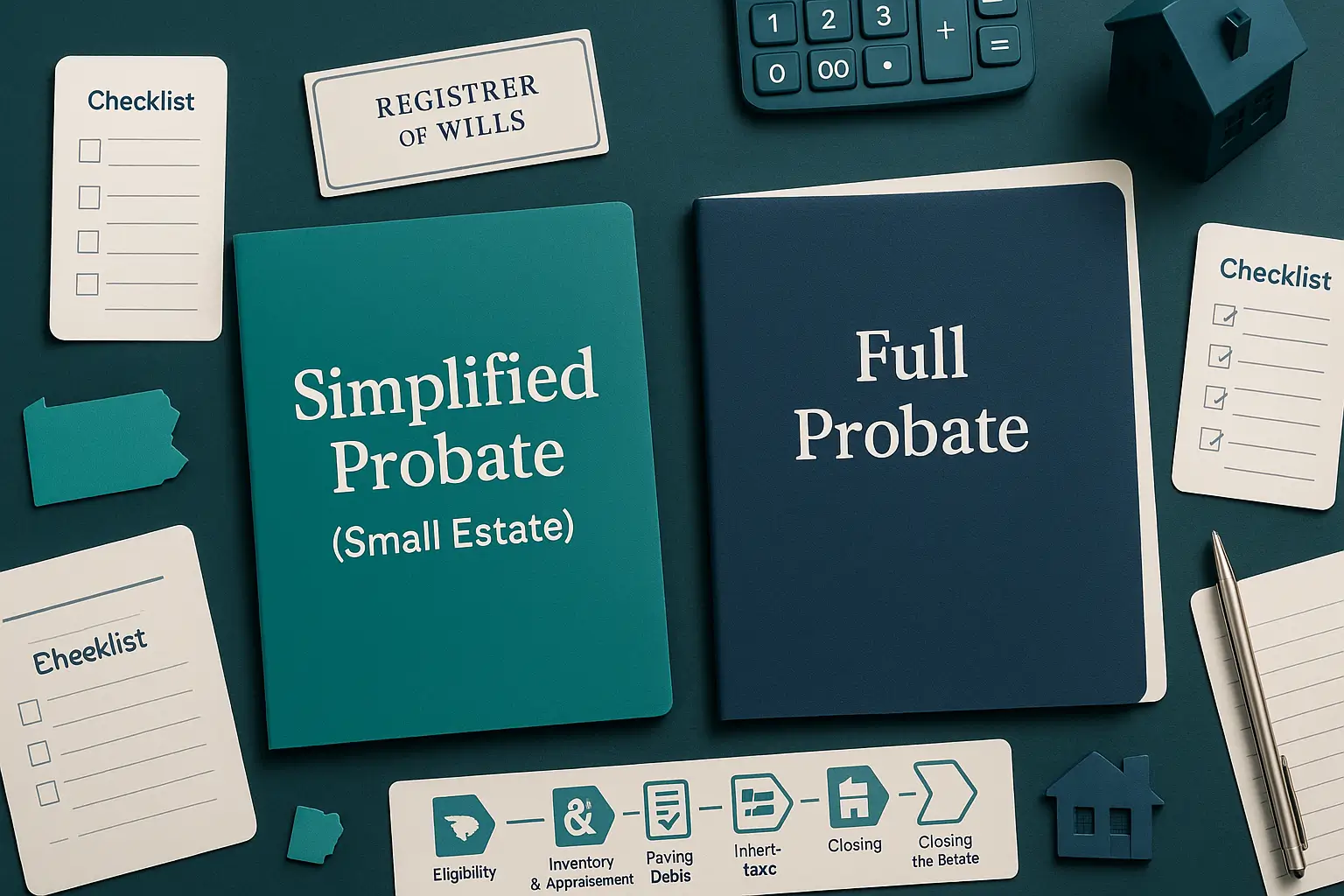
Simplified Probate vs Full Probate
Find out whether an estate qualifies as a Pennsylvania small estate and how the process differs.
Learn more:
Pennsylvania Probate
Process - Main Guide
Return to the complete, step-by-step overview of probate in Pennsylvania.
Learn more →
Frequently Asked Questions
How long does probate take in Pennsylvania?
Most Pennsylvania probate cases take between 9 and 15 months to complete. Complex estates or disputes can take longer.
What is the fastest a Pennsylvania estate can be completed?
Simple estates with no disputes may close in as little as 6 to 9 months. Timely filings and accurate records help shorten timelines.
What causes probate delays in Pennsylvania?
Delays are commonly caused by missing documents, late tax filings, disputes, or incomplete inventories. Executor errors are a frequent factor.
Does probate take longer if there is real estate?
Yes. Estates with real estate often take longer due to appraisals, sales, or title transfers. Additional court filings may be required.
Can beneficiaries speed up the probate timeline?
Beneficiaries can help by responding promptly and avoiding disputes. Executors control most timing decisions.
Is there a required waiting period before closing an estate in PA?
Yes. Certain creditor and tax periods must pass before final distribution can occur. These waiting periods protect all parties.
Can an executor be penalized for delaying probate?
Yes. Executors may face consequences if delays are caused by negligence or failure to act. Courts expect reasonable progress.
H2 Heading (Section Title)
This is a Paragraph Font
- Bullet List 1
- Bullet List 2
- Bullet List 3
- Bullet List 4
- Bullet List 5
Why Our Process Works
This is a Paragraph Font
Need Help Staying on Track With Probate?
Managing probate timelines can be challenging, especially when responsibilities overlap. If you want help understanding where you are in the process and what steps come next, guidance can make the process smoother and less stressful.
Clear, step-by-step guidance
Support for executors and families
Pennsylvania probate focused
Executor & Personal Representative Help
Real Estate, Property & Assets
Selling a Probate Property in Pennsylvania
Probate Real Estate Preparation
Property Issues in Probate
Probate Appraisals & Valuations
Taxes, Costs & Financial Issues
Contested Wills in Pennsylvania
Probate Disputes & Litigation
Questions About Wills
Intestate Estates in PA
Wills, Disputes & Legal Issues
Contested Wills in Pennsylvania
Probate Disputes & Litigation
Questions About Wills
Intestate Estates in PA